
Job Execution Tool (JET) software
JET is a simulation data management application for routine simulation work. It provides a framework for consistent and efficient analysis.
Routine application areas are defined as templates within the tool by an experienced or group of experienced engineers. After this initial set-up, the template can be used with confidence by other users within the organisation, safe in the knowledge that the appropriate physics and meshing rules are captured within the template and will be automatically enabled within the simulation software of choice. There are many benefits to this approach:
- the framework automatically provides an audit trail for all project completed using the tool
- the tool accelerates the simulation set-up and eliminates many of the opportunities for error
- the underlying database can be easily interrogated by experienced engineers, which enables thorough checks to be made on analyses in an efficient manner
- the tool enables post-processing operations to be automated, which can provide significant time savings.
JET graphical user interface:
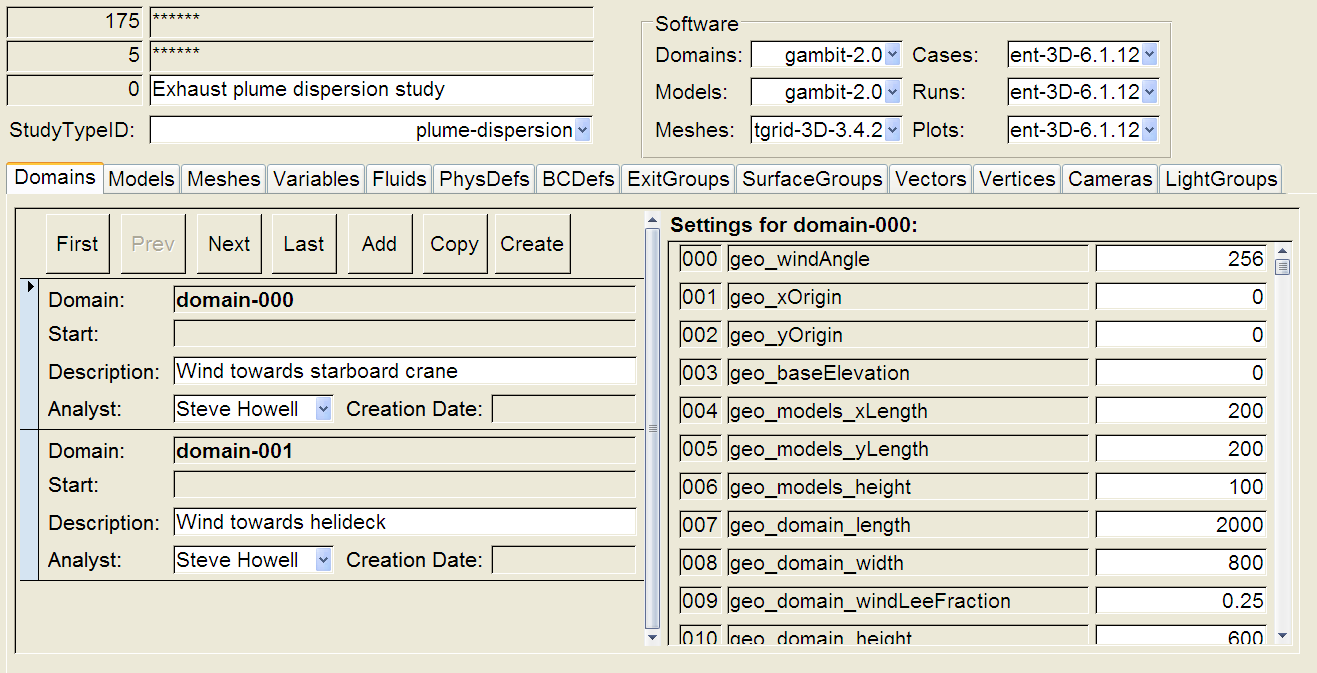
The physics required for describing the turbulent atmospheric boundary layer are already captured within the JET template, together with a mesh adaption technique that will successively refine the mesh along the path of the plume during the course of each simulation. The user can, therefore, focus upon the application-specific requirements such as which combinations of wind direction, wind speed and release scenario to consider, rather than on the generic CFD set-up captured within the template.
JET was first written in 2002 by Steve Howell and Simon Feven during their time together at Mobius Dynamics. Abercus is currently developing a new JET engine, which will incorporate a web-based interface to allow remote access to the simulation data.